Grade 10 CBSE
May 20, 2025 2025-07-29 15:51Grade 10 CBSE
Course Description
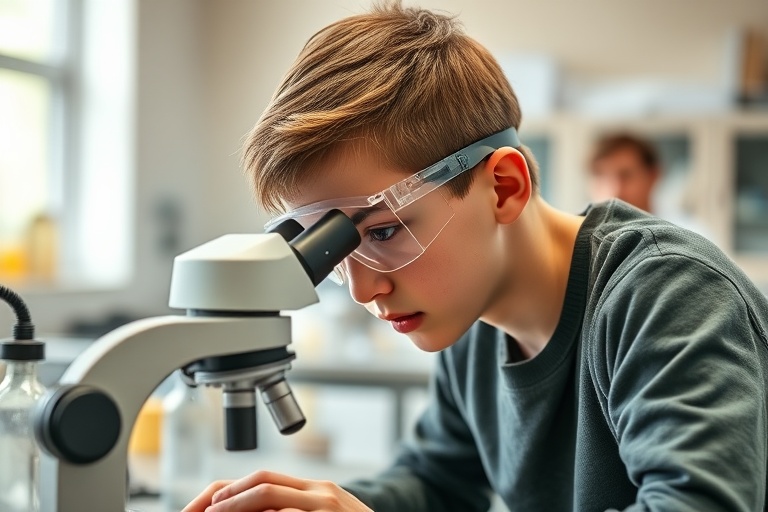
The Grade 10 CBSE program delivers a structured and comprehensive academic foundation in Mathematics and Science, fully aligned with the CBSE curriculum. In Mathematics, students engage with advanced concepts including algebra, trigonometry, statistics, and coordinate geometry to build strong analytical and problem-solving skills. Science instruction spans Physics, Chemistry, and Biology with a focus on real-world applications, concept clarity, and scientific reasoning. The curriculum integrates board-oriented theory with visual learning, numerical practice, and hands-on exploration to equip learners with the competence needed for board exams and beyond.
Learning Objective
This course is designed to strengthen problem-solving accuracy, logical structuring, and conceptual depth across mathematical and scientific domains. Students will apply formulas, interpret graphs, solve equations, and explain processes across electric circuits, chemical reactions, and biological systems. The curriculum enhances written expression, board-style answer framing, and time-bound reasoning. It also nurtures inquiry, encourages application-based thinking, and develops a clear scientific perspective through structured practice, visual tools, and embedded assessments throughout the academic year.
What Will I Learn?
Students will explore a wide range of theoretical and practical topics with an application-based approach. In Mathematics, they’ll gain fluency in solving linear and quadratic equations, applying trigonometric ratios, and working with data. Science modules will involve interpreting electric circuits, understanding magnetic fields, analyzing reflection and refraction, balancing chemical reactions, and explaining heredity and life processes. Learners will engage deeply with structured diagrams, derivations, and reasoning exercises, sharpening their ability to analyze, explain, and solve problems confidently—preparing them for the academic rigor and expectations of senior secondary education.
Additional Info

Practice
Regular exercises and interactive activities to reinforce key concepts in each subject.

Doubt-Solving
Dedicated sessions to address and clarify any questions or difficulties students encounter.

Reports
Detailed reports on experiments and projects to track progress and understanding.
Showing search results
Mathematics
Physics
Biology
Chemistry
Real Numbers
Euclid’s Division Lemma
The Fundamental Theorem of Arithmetic
Rational and Irrational Numbers
Polynomials
Introduction to Polynomials
Zeroes of a Polynomial
Relationship Between Zeroes and Coefficients
Pair of Linear Equations in Two Variables
Graphical Method
Substitution and Elimination Methods
Applications
Quadratic Equations
Roots of a Quadratic Equation
Factorisation and Quadratic Formula
Nature and Sum/Product of Roots
Arithmetic Progressions
nth Term of an AP
Sum of n Terms
Arithmetic Mean
Triangles
Similar Figures
Basic Proportionality Theorem
Criteria for Similarity
Coordinate Geometry
Distance Formula
Section Formula
Coordinate Plane Basics
Trigonometry
Trigonometric Ratios
Trigonometric Identities
Specific Angles
Applications of Trigonometry
Heights and Distances
Angle of Elevation and Depression
-
Circles
Properties of Chords
Tangents to a Circle
Common Tangents
Areas Related to Circles
Perimeter and Area
Area of Sector and Segment
Plane Figures Combinations
Surface Areas and Volumes
Surface Area of Solid Combinations
Volume of Solid Combinations
-
Statistics
Mean
Median
Mode of Grouped Data
Probability
Probability Basics
Sample Space and Events
Card-based Probability
Light Reflection and Refraction
Spherical Mirrors
Ray Diagrams
Mirror and Lens Formulae
The Human Eye and Colorful World
Structure of Eye
Prism and Dispersion
Scattering and Atmospheric Refraction
Electricity
Electric Current and Potential
Ohm’s Law
Resistance and Power
Magnetic Effects of Electric Current
Magnetic Fields
Electromagnetic Force
Domestic Circuits
Life Processes
Nutrition
Respiration
Transportation and Excretion
Control and Coordination
Nervous System
Plant Movements
Hormonal Control
How do Organisms Reproduce?
Asexual and Sexual Reproduction
Human Reproductive Systems
Reproductive Health
Heredity
Mendel’s Laws
Variation and Inheritance
Sex Determination
Our Environment
Ecosystem
Food Chains and Pyramids
Ozone and Waste Management
Chemical Reactions and Equations
Types of Chemical Reactions
Chemical Equation Balancing
Oxidation and Reduction
Acids, Bases and Salts
Properties and Uses of Acids and Bases
pH Scale
Common Salts and Their Uses
Metals and Non-metals
Physical and Chemical Properties
Reactivity Series
Extraction and Corrosion
Carbon and Its Compounds
Covalent Bonding
Hydrocarbons and Functional Groups
Properties of Carbon Compounds
No results found matching your query.
Loading PDF access status...
×
Access All Study Materials
Please fill in your details below to access all study materials for this course.
Related Courses
Subjects Includes
Math
Physics
Chemistry
Biology